

Understanding the science behind modern dental crowns, and why choosing the right material matters as much as choosing a skilled dentist.
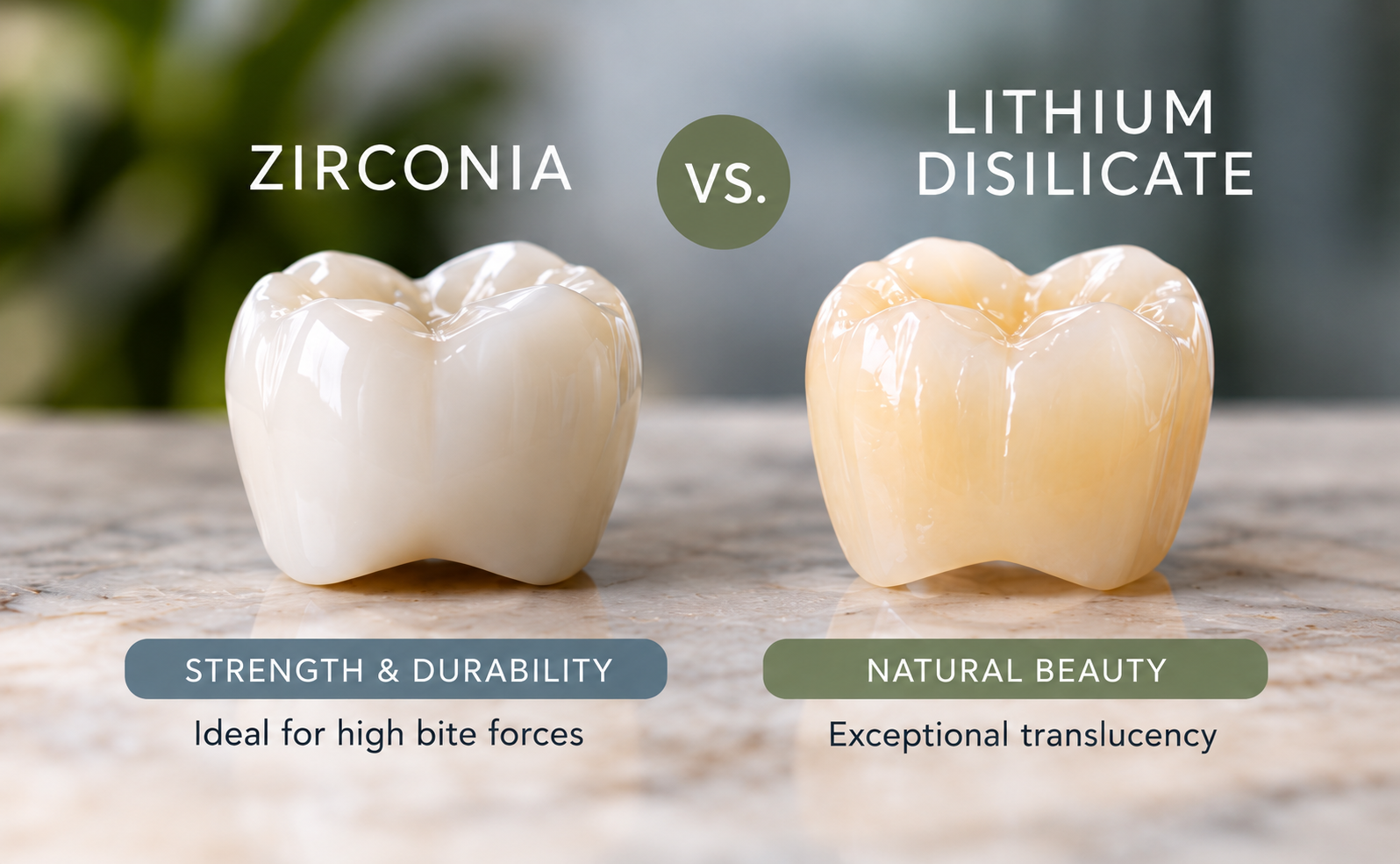
When you need a dental crown, you need more than a restoration that simply looks good. You want something that feels natural, withstands everyday chewing, protects your tooth, and complements your smile for years to come.
At Innovative Dentistry Biltmore in Phoenix, Arizona, Dr. Jennifer Ebner takes an individualized, evidence-based approach to restorative dentistry. Two commonly used ceramic materials, zirconia and lithium disilicate, offer excellent restorative benefits, but each has different pros and cons.
What Does Recent Research Tell Us?
Dental materials have improved dramatically over the years. Clinical research continues to study how today's ceramics perform.
A randomized clinical trial published in July 2026 compared zirconia and lithium disilicate crowns on back molars, including patients with sleep bruxism (teeth grinding). After three years, both materials demonstrated excellent technical stability, with survival rates ranging from 95.2% to 100% across the study groups.
Researchers found no statistically significant difference in survival between the two materials or between patients with and without sleep bruxism.
Another 2026 clinical study reported different results. Researchers evaluating 100 crowns found two-year survival rates of 100% for multilayer zirconia and 82% for a particular lithium-disilicate-based ceramic.
These findings showed that zirconia crowns and lithium disilicate crowns don’t perform equally. Material composition, restoration design, placement technique, and individual patient factors can influence outcomes.
Both ceramics have valuable clinical applications, but choosing a crown should involve more than comparing esthetic needs or material strength.
Zirconia Crowns: Strength Where It Matters
Zirconia is a high-strength dental ceramic valued for its durability and resistance to fracture.
It is useful for back teeth, where chewing generates substantial pressure. Patients with heavy bite forces, extensive restorations, or limited space for crown material benefit from zirconia crowns.
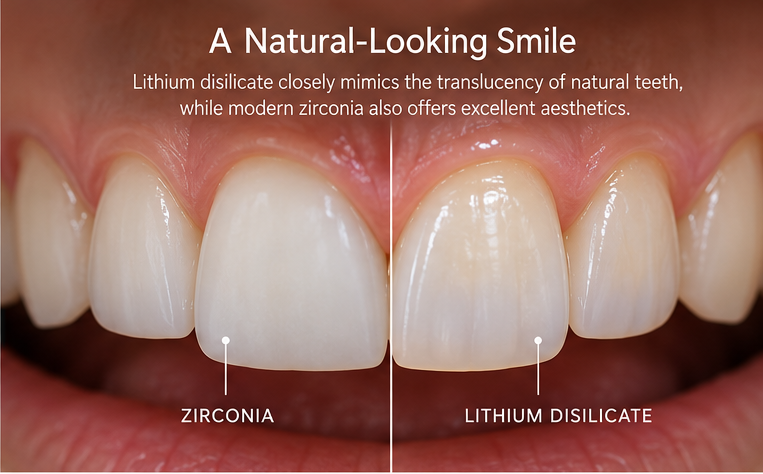
Zirconia used today also offers improved esthetics compared with earlier types. Multilayer and more translucent formulations can closely resemble natural teeth, making zirconia useful in many visible areas.
There is a tradeoff. Increasing zirconia's translucency will reduce of its mechanical strength, depending on the type.
Choosing zirconia is not simply a matter of selecting the strongest available product.
Its greatest advantage is that certain zirconia formulations deliver exceptional strength while allowing relatively conservative restoration thicknesses when clinically needed.
Lithium Disilicate or eMax: Natural Beauty Meets Reliable Performance
Lithium disilicate is a glass-ceramic known for its ability to reproduce the translucent qualities of natural enamel.
Natural teeth are not completely opaque. Light passes through their outer layers, producing subtle variations in brightness, depth, and color.
Lithium disilicate can reproduce these characteristics particularly well, making it an attractive option for front teeth and other highly visible restorations.
It also provides substantial strength when properly designed, bonded, and supported. Research supports its use in both anterior and posterior crowns, although the specific situations and clinical conditions matter.
Another advantage is its ability to bond predictably to tooth surfaces using dental adhesive techniques.
For patients seeking a highly natural appearance, especially when matching neighboring teeth, lithium disilicate can be an excellent choice.
Its greatest advantage is a combination of natural-looking translucency, proven restorative performance, and reliable adhesive bonding.
Why Crown Location and Bite Forces Matter
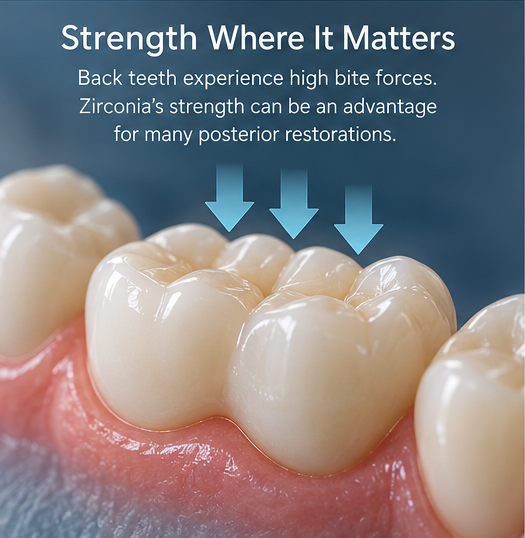
A crown on a front tooth faces different demands than one on a molar.
Front teeth are visible and support lower forces associated with biting and guiding jaw movements than molar teeth. Precise color matching, translucency, and contour are especially important.
Back teeth encounter greater chewing loads, particularly during grinding or clenching.
For posterior restorations, zirconia's fracture resistance provides an advantage. In other situations, lithium disilicate offers sufficient strength alongside excellent aesthetics.
Neither choice should be automatic.
At Innovative Dentistry Biltmore, evaluating your bite, remaining tooth structure, restoration location, and esthetic expectations helps guide the decision.
Preserving Healthy Tooth Structure
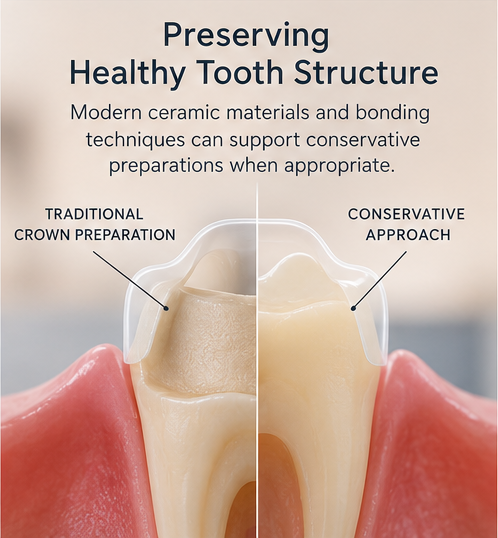
An important goal of modern restorative dentistry is preserving as much healthy natural tooth structure as reasonably possible.
Traditional full-coverage crowns sometimes require substantial tooth reduction. Modern ceramic materials and adhesive techniques support more conservative approaches in appropriate circumstances.
Zirconia crowns can function at relatively thin dimensions, potentially reducing the amount of tooth preparation required.
Lithium disilicate, meanwhile, offers adhesive bonding characteristics that may support partial-coverage restorations such as onlays for a tooth with minimal decay or loss of structure.
Thinner restorations aren’t automatically better. Inadequate thickness, insufficient support, or poor preparation geometry can increase the risk of failure.
A full crown provides necessary protection for a weakened tooth. Requiring less tooth removal by using zirconia over lithium disilicate is preferred when there is not much tooth left after removing cavities.
Our philosophy is to preserve healthy tooth structure while creating a restoration designed for dependable, long-term function.
Does Metal-Free Mean Healthier?
Both zirconia and lithium disilicate are metal-free ceramic materials.
For patients who prefer metal-free dentistry, these options are great solutions without traditional metal or PFM crowns.
It’s not correct to suggest that metal-free crowns are inherently healthier for everyone.
Restoration quality, tissue compatibility, oral hygiene, existing dental conditions, and clinical design all matter. Metal-containing restorations also have a long, established records of longevity for people.
At Innovative Dentistry Biltmore, our biological dentistry philosophy emphasizes thoughtful material selection, prevention, bio-compatibility considerations, and evidence-based treatment.
The Best Crown Is the One Selected for Your Tooth
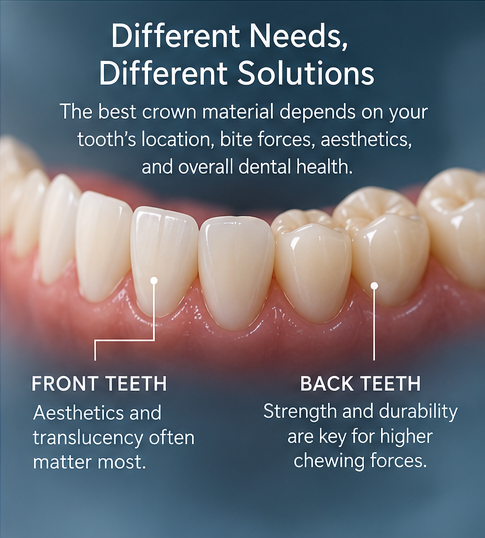
No dental crown material is ideal for every patient or every tooth.
The best decision considers the following
Strength: How much chewing pressure must the crown withstand?
Esthetics: How important are translucency and exact shade matching?
Location: Is the restoration on a front tooth, premolar, or molar?
Tooth preservation: Can healthy tooth structure be maintained through conservative preparation?
Long-term function: How will the restoration interact with your bite and surrounding teeth?
A well-designed crown depends on accurate diagnosis, preparation, fabrication, fit, and ongoing care at home.
Personalized Ceramic Dentistry in Phoenix
Whether you have lived in the Valley for decades or recently relocated to Phoenix, Biltmore, Arcadia, or Scottsdale, finding a restorative dentist who takes time to explain your options matters.
At Innovative Dentistry Biltmore, Dr. Jennifer Ebner combines her clinical experience with a prevention-focused, individualized approach to dental care.
She considers your dental health, personal priorities, cosmetic goals, and the latest available scientific evidence instead of recommending one material for every situation.
Considering a new crown or replacing an older restoration?
Schedule a comprehensive exam at Innovative Dentistry Biltmore in Phoenix. Together, we can explore whether zirconia, lithium disilicate, or another restorative option is best suited to protecting your tooth and maintaining a confident, natural-looking smile.
REFERENCES
2026 randomized clinical trial: Ceramic crowns and sleep bruxism: 3-year results of a randomized controlled trial. Journal of Dentistry, July 2026.
2026 comparative clinical study: Hausdörfer T, et al. Clinical performance of CAD/CAM-fabricated lithium-disilicate-based glass ceramic vs. multilayer zirconia crowns after a minimum observation period of two years. Dental Materials, August 20, 2026.
2025 umbrella review: Clinical outcomes and complications of tooth- and implant-supported lithium (di)silicate based single crowns. Journal of Dentistry, 2025.