Sleep Apnea Oral Appliances in Phoenix in 2026: A Comfortable CPAP Alternative for Some Patients
If you have sleep apnea but struggle to wear your CPAP every night, you are not alone. Some people find the mask uncomfortable, dislike traveling with the equipment, or simply cannot sleep well while wearing it.
For certain patients, a small custom dental appliance may provide another option.
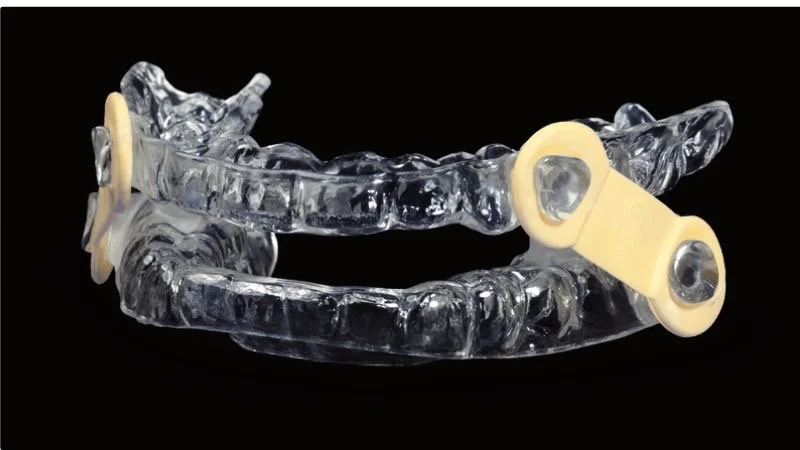
At Innovative Dentistry Biltmore in Phoenix, Dr. Jennifer Ebner uses mandibular advancement appliances as part of a medically diagnosed sleep-apnea treatment plan. These custom devices fit over your teeth and gently move your lower jaw forward while you sleep, helping create more room for air to move through your airway.
A large study published in September 2026 provides encouraging information about how well these appliances can work—and also highlights why every patient should be treated a little differently.
What Did the New Sleep Apnea Study Find?
The September 2026 study followed 300 people with obstructive sleep apnea who were treated with adjustable oral appliances.
Researchers looked at how often each person stopped or significantly reduced breathing during sleep. This measurement is called the apnea-hypopnea index, or AHI.
Before treatment, patients averaged about 31 breathing interruptions per hour. After treatment with an oral appliance, that number dropped to about 15 per hour.
Researchers also measured how often blood oxygen levels dropped during sleep. Those oxygen drops decreased significantly as well.
In simple terms, the appliances made a meaningful difference for many of the patients in the study.
But researchers discovered something equally important:
Moving the jaw farther forward did not necessarily produce better results.
That finding matters because successful oral appliance therapy is not about pushing your jaw as far forward as possible. It is about finding the position that works best for you.
How Does an Oral Appliance Help Sleep Apnea?
When you fall asleep, the muscles around your tongue and throat relax. In someone with obstructive sleep apnea, the airway can become too narrow or temporarily close.
A mandibular advancement appliance holds the lower jaw slightly forward.
Because the tongue and other soft tissues are connected to the jaw, this forward position may help keep the airway more open while you sleep.
The appliance looks somewhat like a dental night guard, although it is designed very differently and is made specifically for sleep apnea treatment.
Patients searching for oral appliance sleep apnea Phoenix treatment often like that these appliances are small, quiet, comfortable do not require electricity and are easy to travel with.
But they are not simply something you buy, put in your mouth and forget about.
Why Isn't More Jaw Advancement Always Better?
It would seem logical that if moving the jaw forward helps open the airway, moving it even farther should work even better.
The 2026 research suggests it is not that simple.
Every person's airway, jaw, teeth and sleep apnea are different. Some people may experience a significant improvement with relatively little jaw movement. Others may need additional advancement.
Moving the jaw too far can also make an appliance unnecessarily uncomfortable.
This is why Dr. Ebner gradually adjusts, or titrates, the appliance rather than immediately setting it at its maximum position.
Think of it more like adjusting the prescription on a pair of glasses than turning a switch on or off. Dr. Ebner is looking for the setting that gives you an effective result while still being comfortable enough to wear throughout the night.
Comfort Is an Important Part of Treatment
A sleep apnea treatment cannot help if you cannot comfortably use it.
During oral appliance therapy, Dr. Ebner pays attention to more than your airway.
She also monitors:
Your teeth
Your bite
Your jaw joints
Jaw muscle tenderness
How comfortably you can sleep with the appliance
Any changes that develop over time
Some people initially have mild tooth or jaw soreness as they adjust to the appliance. Long-term use can also gradually change the way the teeth come together in some patients.
Regular dental follow-up at Innovative Dentistry Biltmore helps Dr. Ebner identify these changes early rather than waiting until they become a larger problem.
How Do You Know If Your Oral Appliance Is Actually Working?
This is one of the most important parts of sleep apnea treatment.
You might notice that you are snoring less. Your spouse may say you are sleeping more quietly. You may wake up feeling better.
Those are all positive signs.
But feeling better does not necessarily mean your sleep apnea has been adequately treated.
The only way to know what is happening with your breathing and oxygen while you sleep is through objective follow-up sleep testing.
After your appliance has been adjusted to a comfortable position, your sleep physician may recommend another sleep study or home sleep test while you are wearing the device.
That allows Dr. Ebner to answer a much more important question than, “Are you snoring less?”
She wants to know:
Is the appliance actually controlling your sleep apnea?
If it is not, the appliance may need further adjustment by Dr. Ebner or your physician may recommend another treatment.
Is an Oral Appliance Better Than CPAP?
Not necessarily.
CPAP remains one of the most effective treatments available for obstructive sleep apnea, particularly for people with more severe disease. It uses gentle air pressure to keep the airway from collapsing during sleep.
If you use CPAP successfully and feel comfortable with it, there may be no reason to change.
Oral appliance therapy becomes particularly useful for appropriately selected patients who have been diagnosed with obstructive sleep apnea but have trouble consistently using CPAP, or who want to discuss an alternative with their sleep physician.
That is why patients searching for a CPAP alternative in Phoenix should not simply stop using CPAP and replace it with an oral appliance on their own.
Sleep apnea is a medical condition, and treatment should be coordinated appropriately.
Can an Oral Appliance Help With Snoring?
It often can, because moving the jaw forward may reduce the vibration of tissues that causes snoring.
But snoring and sleep apnea are not the same thing.
Some people who snore do not have sleep apnea. Others may have significant sleep apnea without realizing it.
If you are looking for snoring treatment in Phoenix, especially if your snoring is accompanied by gasping during sleep, witnessed breathing pauses, daytime fatigue or morning headaches, proper medical evaluation should come first.
Treating the sound of snoring without knowing whether sleep apnea is present can miss the more important issue. Dr. Ebner requires a sleep study as part of her patient evaluation for snoring before she prescribes a sleep appliance.
Who Should I See for Sleep Apnea Oral Appliance Treatment in Phoenix?
A dentist trained in dental sleep medicine can evaluate your teeth, jaw joints, bite and oral health to determine whether you are a good candidate for an appliance.
The diagnosis of obstructive sleep apnea, however, should be made through the appropriate medical sleep evaluation.
At Innovative Dentistry Biltmore in Phoenix, Arizona, Dr. Jennifer Ebner works with patients who have already been diagnosed with sleep apnea and are interested in learning whether a custom mandibular advancement appliance may fit into their treatment plan.
For someone searching for a sleep apnea dentist Phoenix, the important question is not simply whether the office provides an appliance. Look for care that includes individualized adjustment, attention to your bite and jaw health, ongoing follow-up and objective confirmation that treatment is working.
Looking for a CPAP Alternative in Phoenix?
If you have already been diagnosed with obstructive sleep apnea but are struggling to comfortably or consistently use CPAP, a custom oral appliance may be worth discussing with your sleep physician and dentist.
At Innovative Dentistry Biltmore, Dr. Ebner provides individualized mandibular advancement therapy for appropriate patients in Phoenix and surrounding communities, with careful attention to comfort, jaw health, bite stability and treatment effectiveness.
Schedule a sleep apnea oral appliance consultation with Dr. Ebner at Innovative Dentistry Biltmore in Phoenix to find out whether mandibular advancement therapy may be an appropriate part of your treatment plan.
References
Bronwasser CS, Bronwasser PJ, Schimmel M, Abou-Ayash S, Hou MY. The Effect of Different Mandibular Advancement Devices on Sleep Parameters in Obstructive Sleep Apnea. Journal of Oral Rehabilitation. Published online September 1, 2026. PMID: 42680687.
This is the primary study referenced in the article. It included 300 patients and found an average reduction of 16.4 events/hour in AHI and 10.8 events/hour in oxygen desaturation index (ODI), representing roughly a 50% average improvement. Importantly, greater mandibular protrusion did not produce greater average reductions in AHI or ODI. Wiley Online LibraryRamar K, Dort LC, Katz SG, Lettieri CJ, Harrod CG, Thomas SM, Chervin RD. Clinical Practice Guideline for the Treatment of Obstructive Sleep Apnea and Snoring With Oral Appliance Therapy: An Update for 2015. Journal of Clinical Sleep Medicine. 2015;11(7):773–827. doi:10.5664/jcsm.4858.
Joint clinical guideline from the American Academy of Sleep Medicine (AASM) and American Academy of Dental Sleep Medicine (AADSM) supporting custom, titratable appliances; dental monitoring for bite and dental changes; follow-up sleep testing; and coordinated care with a sleep physician. PubMed Central (PMC)American Academy of Sleep Medicine and American Academy of Dental Sleep Medicine. Oral Appliance Therapy Clinical Guideline.
The guideline notes that oral appliance therapy may be considered for adults with obstructive sleep apnea who cannot tolerate CPAP or prefer an alternative. It also emphasizes that CPAP generally produces greater improvements in AHI and oxygen saturation, so oral appliances should not be presented as universally superior to CPAP.